

How Often Do People Get Killed By Animals
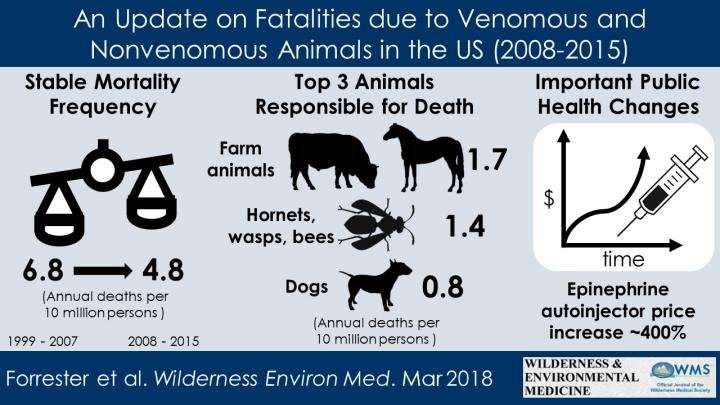
A new report released in the latest issue of Wilderness & Environmental Medicine shows that beast encounters remain a considerable crusade of human damage and expiry. Researchers analyzed fatalities in the United States from venomous and nonvenomous animals from 2008-2015. They establish that while many deaths from animate being encounters are potentially avoidable, mortality rates did non decrease from 2008-2015. The animals most commonly responsible for human being fatalities are farm animals, insects (hornets, wasps, and bees), and dogs.
In a follow-up to their previous study looking at data from 1999-2007, researchers from Stanford Academy used the Centers for Illness Control and Prevention's Wide-Ranging Online Data for Epidemiologic Research (WONDER) database to collect data by blazon of animal and individuals' age, race, sex, and region where the fatalities occurred. They plant that from 2008-2015, in that location were 1,610 animal-related fatalities in the US, with the majority of deaths the result of encounters with nonvenomous animals (57 percent).
"From this search, we found that the rates of death from encounters with animals has remained relatively stable from the last fourth dimension nosotros preformed this assay (1999-2007)," remarked lead investigator Jared A. Forrester, MD, Department of Surgery, Stanford University. "Importantly, about deaths are not really due to wild fauna similar mount lions, wolves, bears, sharks, etc., but are a result of deadly encounters with farm animals, anaphylaxis from bees, wasps, or hornet stings, and dog attacks. So, while it is of import that people recreating in the wilderness know what to exercise when they encounter a potentially dangerous beast, the bodily chance of death is quite low."
During the report menses, there were about 86 deaths annually from venomous brute encounters. This is upward from 79.5 in 1999-2007, 69 in 1991-2001, threescore in 1979-1990, and 46 from 1950-1959. The nearly lethal venomous animal run across remained stings and subsequent anaphylaxis from bees, wasps, and hornets despite the availability of life-saving treatment for anaphylaxis. "Africanized" honey bees may be particularly lethal when they swarm and are increasingly common in the southern and western United states of america.
People with known allergic reactions to bee stings should deport a portable epinephrine delivery device with them at all times. "With an estimated 220,000 annual visits to the emergency department and nearly 60 deaths per year due to stings from hornets, wasps, and bees, effective and affordable treatment for anaphylaxis from Hymenoptera is critical," said Dr. Forrester. "Public health practitioners, policymakers, and the public should encourage industry to provide proven public health interventions, like the EpiPen, at a socially responsible price bespeak that serves the best interests of the Us population."
The well-nigh common nonvenomous encounter grouping in the study was "other mammals," which includes cats, horses, cows, other hoof stock, pigs, raccoons, and other mammals. Previous studies determined that the majority deaths associated with "other mammals" occur on farms and that horses and cattle account for 90 per centum of farm accidents.
"Preventing potentially fatal subcontract animal encounters should be a better promoted and supported public health initiative," explained Dr. Forrester. "Farming remains an industry with a deficit of work-related injury reporting, and opportunities exist to ameliorate safety measures and injury reporting on farms in the Usa."
Second to "other mammals," the report found that dogs are the side by side most common blazon of fatal nonvenomous animate being come across, with children under 4 years of age having the highest dog-related fatality rate (iv.6 deaths per 10 million persons). The charge per unit of children under four years of age killed by dogs was about two times college than the side by side most vulnerable group (persons older than 65 years of age) and four times higher than other historic period groups.
According to Dr. Forrester, "The burden of fatality upon young children afterwards dog encounters remains troubling. These are preventable deaths."
Accounting for around 201 deaths annually, mortality resulting from animals is a public health expanse of interest. Each year in the US solitary, over one one thousand thousand emergency room visits and approximately $two billion in healthcare spending are owing to problematic animal encounters. Both deaths and high medical costs could exist cutting down through education, prevention methods, and targeted public policy.
Understanding the underlying reasons for why people die from animal encounters may aid prevent them in the time to come. "Unfortunately, deaths due to human being-creature encounters did not decrease from our prior study. Brute-related deaths in 'controllable' situations, such as on the farm or in the home, still account for the majority of the deaths. Little in the fashion of public wellness policy in the subcontract workplace has changed since our previous newspaper," concluded Dr. Forrester. "Increased specificity in the coding of deaths due to animals in farm environments would assistance public wellness professionals target interventions.
More information: Jared A. Forrester et al, An Update on Fatalities Due to Venomous and Nonvenomous Animals in the United states of america (2008–2015), Wilderness & Ecology Medicine (2018). DOI: 10.1016/j.wem.2017.ten.004
Citation: Number of people killed past animals each yr in the US remains unchanged (2018, February 28) retrieved 23 June 2022 from https://phys.org/news/2018-02-people-animals-year-unchanged.html
This document is subject to copyright. Apart from any fair dealing for the purpose of private written report or inquiry, no part may be reproduced without the written permission. The content is provided for data purposes only.
Source: https://phys.org/news/2018-02-people-animals-year-unchanged.html
Posted by: ellisamine1986.blogspot.com
0 Response to "How Often Do People Get Killed By Animals"
Post a Comment